The official June 1 start of hurricane season is here, and disaster relief nonprofits like Team Rubicon are already preparing for what may come—and urging Americans to do the same. While the National Oceanic and Atmospheric Administration’s 2026 hurricane season forecast projects a below-normal season for the Atlantic basin, disaster responders are urging Americans not to let a quieter forecast lead to delayed preparations. As every Team Rubicon volunteer, or Greyshirt, who has ever served on a hurricane relief operation can attest, it only takes one hurricane to make for a very bad year for those in its path.
Key Predictions for the 2026 Hurricane Season
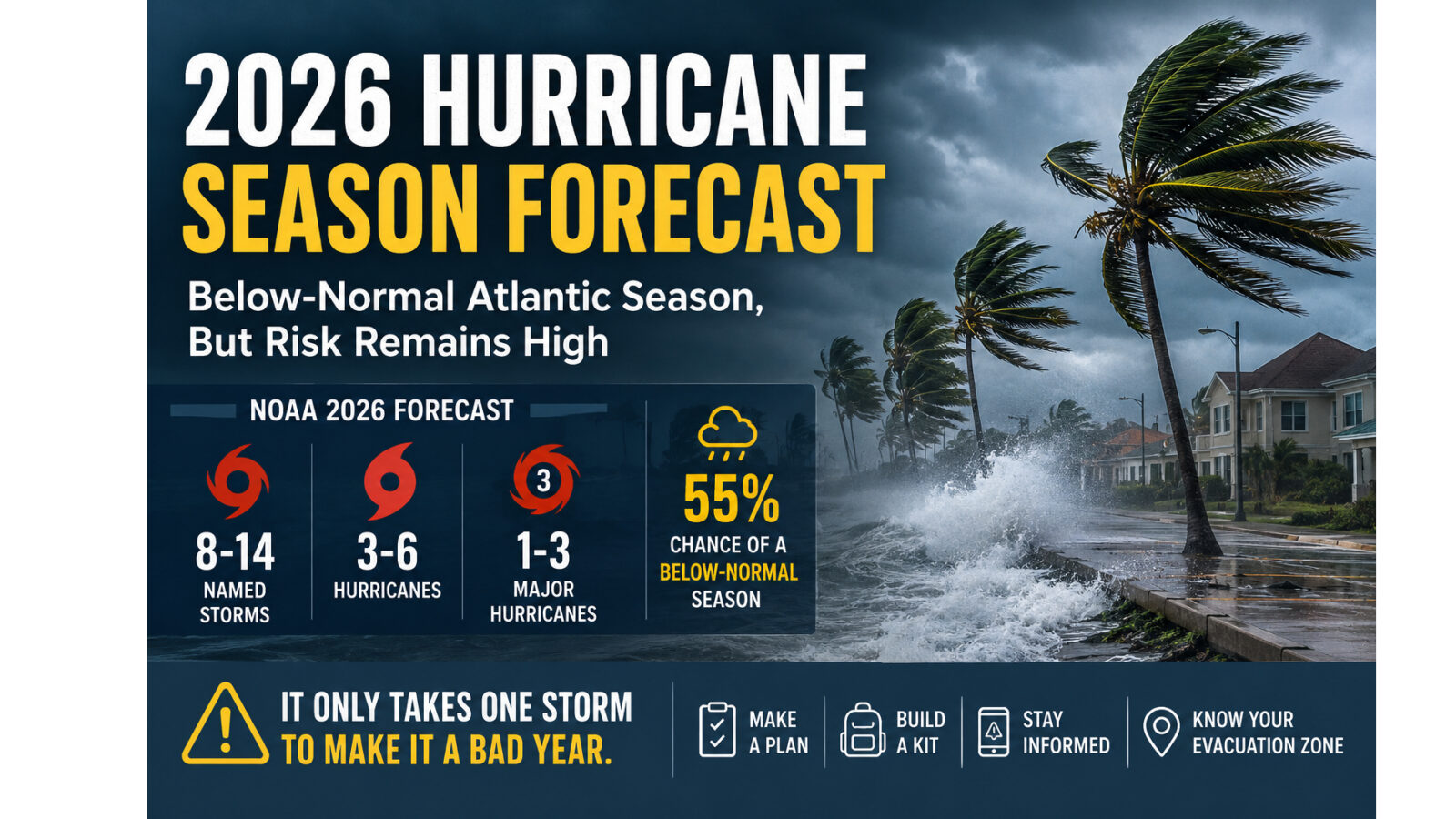
NOAA’s Climate Prediction Center is forecasting a 55% chance of a below-normal season, a 35% chance of a near-normal season, and only a 10% chance of an above-normal season. The agency is predicting eight to 14 total named storms, of which three to six are forecast to become hurricanes, and one to three are predicted to reach major hurricane status.
For context, an average Atlantic season produces 14 named storms, seven hurricanes, and three major hurricanes. In 2025, the Atlantic basin produced 13 named storms, of which five became hurricanes, and four reached major hurricane status—Category 3, 4, or 5. Included among them was the Category 5 Hurricane Melissa, which made landfall in southwestern Jamaica on October 28. For the first time in a decade, not a single hurricane struck the continental U.S.
Colorado State University’s Tropical Meteorology Project, which released its initial 2026 forecast on April 9, is aligned with NOAA’s outlook. CSU is forecasting 13 named storms, six hurricanes, and two major hurricanes—all below the 1991–2020 historical averages of 14.4 named storms, 7.2 hurricanes, and 3.2 major hurricanes. CSU’s forecast also calls for below-average probability of major hurricane landfalls along the continental U.S. coastline and in the Caribbean.
What’s Driving the Quieter 2026 Hurricane Season Forecast?
Both NOAA and CSU point to competing climate forces shaping this year’s outlook, with El Niño story.
Current weak La Niña conditions are expected to transition to El Niño in the coming months, with the potential for a moderate to strong El Niño by the peak of hurricane season. El Niño typically suppresses Atlantic hurricane activity by increasing vertical wind shear—the change in wind speed and direction with altitude—which disrupts storm formation and prevents storms from intensifying.
That said, not all factors are pointing toward a quiet season. Ocean temperatures in the western tropical Atlantic remain warmer than normal, and trade winds are likely to be weaker than average—both conditions that, in isolation, would favor more storm activity. CSU notes that sea surface temperatures in the eastern and central tropical Atlantic are running slightly cooler than normal, which partially offsets the warmer western Atlantic.
The bottom line: El Niño’s suppressing influence is expected to be the dominant factor, but the competing warm ocean temperatures introduce uncertainty into the forecast, and the season could evolve differently than projected.
Below Normal Doesn’t Mean Risk-Free
A below-normal forecast can create a dangerous false sense of security. History has shown that even quiet hurricane seasons can produce catastrophic storms.
In 2024, NOAA predicted a historically active season. That forecast was verified dramatically with 18 tropical storms, of which 11 became hurricanes, and five major hurricanes. Hurricane Helene alone became a $78.7 billion disaster, with its most devastating impacts reaching far inland, producing historic rainfall and flooding across western North Carolina, southwestern Virginia, and extreme eastern Tennessee.
But the inverse lesson is equally true: even in below-normal seasons, a single storm making landfall near a populated area can be catastrophic. NOAA National Weather Service Director Ken Graham emphasized the point in the 2026 forecast release: “Although El Niño’s impact in the Atlantic Basin can often suppress hurricane development, there is still uncertainty in how each season will unfold. That is why it’s essential to review your hurricane preparedness plan now.”
CSU echoes that message, closing its forecast summary with a reminder that “coastal residents are reminded that it only takes one hurricane making landfall to make it an active season. Thorough preparations should be made every season, regardless of predicted activity.”
What the 2026 Hurricane Season Forecast Could Mean for the American South
No forecast can predict specific landfalls, and below-normal activity in the Atlantic basin as a whole doesn’t eliminate risk for any particular coastline. The Gulf of Mexico, the Eastern Seaboard, and Caribbean communities all remain at risk throughout the June 1–November 30 season. The historical peak of Atlantic hurricane season runs from mid-September through October.
Importantly, 2024 served as a powerful reminder that hurricane danger doesn’t stop at the coast. Inland communities—far from any shoreline—can bear the brunt of a major storm. Communities preparing only for wind and storm surge may be caught off guard by catastrophic freshwater flooding far from the coast.
2026 Hurricane Preparedness Tips
With another hurricane season underway, Team Rubicon—which spent more than 200 days aiding communities after Hurricane Helene—emphasizes that the time to prepare is before a storm forms, not after one is named.
Must-Do Hurricane Preparedness Steps
- Create and regularly update an emergency plan for your household, including pets and anyone with medical needs.
- Build a hurricane emergency kit stocked with three to five days of non-perishable food and one gallon of water per person per day, plus essential medications.
- Stay informed through reliable weather apps, NOAA alerts, and your local emergency management agency.
- Know your evacuation zone and nearest shelter before a storm is ever in the forecast.
Knowing when and how to evacuate, having a way to receive warnings, knowing your evacuation zone, and knowing where your nearest emergency storm shelter is are all essential to hurricane preparedness. Having a go bag packed and ready to go—one that includes medication and supplies for pets—is critically important.
Even for those who cannot evacuate, having a plan and emergency supplies on hand can be lifesaving. That’s because some folks may not be able to evacuate or are in an area that’s impacted unexpectedly. That’s why Team Rubicon recommends that everybody have on hand some emergency supplies to carry them through if they’re impacted by a storm, including a gallon of water per person per day for at least three to five days, as well as non-perishable food items. And, of course, a can opener.
Final Word: A Quieter Forecast Is Not a Pass on Preparation
Forecasters will continue updating their 2026 hurricane outlooks throughout the season: NOAA plans to release an updated forecast in early August, and CSU will issue updates on June 10, July 8, and August 5. But forecasts change, and seasons surprise.
Whether 2026 brings eight storms or 14, the right actions taken today could protect lives and property when a storm does form. Team Rubicon urges all Americans—especially those in coastal and low-lying areas in the South and along the Eastern Seaboard—to take hurricane preparedness seriously, every season, regardless of what the forecasts say.
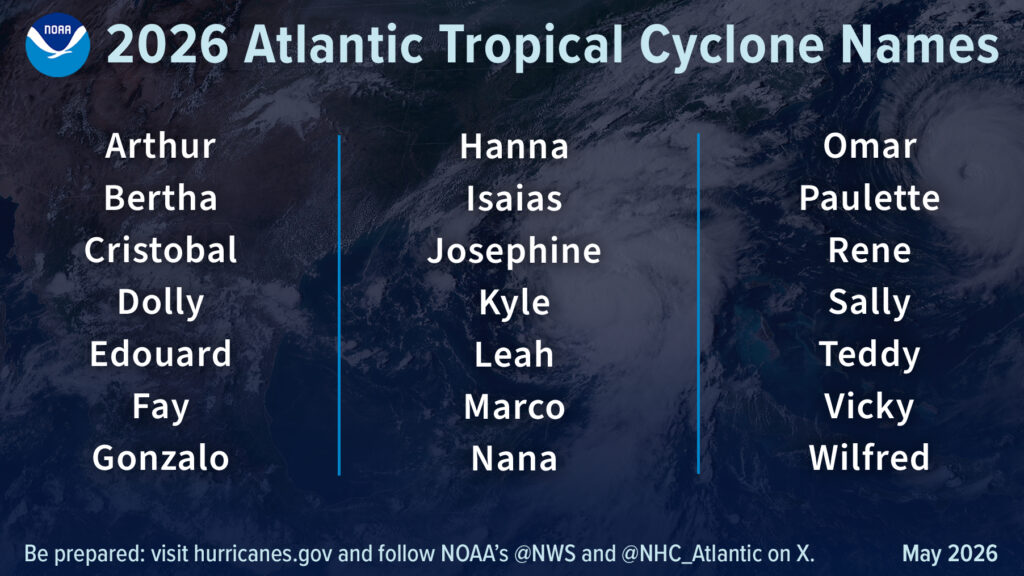
2026 Hurricane Season Names
How Hurricanes Get Their Names
Tropical storms and hurricanes are given short, distinctive names—determined by the World Meteorological Organization—to avoid confusion and streamline communications, and the storms progress alphabetically.
In the Atlantic and Southern Hemisphere, tropical storms, cyclones, and hurricanes are named alphabetically, alternating men’s and women’s names. In the U.S., from 1953 until 1978, all storms used female names. In 1979, male names were added to the mix for storms in the Atlantic basin.
Should a season produce more storms than the 21 names provided, storms will be named from the WMO’s supplemental list. Only two years in recorded history have produced more than 21 named tropical storms in the Atlantic basin: the record-shattering year of 2005, which produced 28 storms, including Hurricane Katrina, and 2020, which produced 30 storms, including Hurricanes Delta, Laura, and Zeta.

