
“Have you ever arrived at a disaster site where one of your most capable volunteers couldn’t fully participate—because nobody planned for it?”
It’s a question that stops most Greyshirt leaders cold because the answer, for too many of us, is “Yes.” A veteran with a prosthetic gets sidelined on a mitigation operation because nobody surveyed the terrain for slope and angle, for example. A deaf volunteer misses the day’s team assignments because the morning brief was held in a loud staging area without written backup. A Greyshirt managing a TBI quietly struggles through rapid-fire instructions as they try to keep pace.
These aren’t one-offs or edge cases: They’re real examples of life in the TRibe, and every time an operation fails to account for visible and invisible disabilities within the Greyshirt cohort, we’re not only not putting Mission First, we’re also leaving capability on the table.
Fixing such things—getting full capacity and living Team Rubicon’s cultural values and service princples—was at the heart of Universal Design for Operations (UDO), a session recently presented at a regional leadership conference that reframed inclusion not as a feel-good policy, but as an operational strategy with measurable mission impact.
What is Universal Design?
Universal design is the practice of creating environments, products, and digital systems that are naturally accessible to all people—regardless of age, size, or ability—without the need for specialized adaptation. With inclusivity at its core, universal design replaces exclusionary structures with everyday solutions that inherently benefit everyone. The philosophy shifts the focus away from retrofitting spaces for specific disabilities and instead treats human diversity as the norm from the start.
Since its implementation into architecture and built environments, universal design has been incorporated into websites, digital interfaces, and more. Now, at Team Rubicon, it’s also being incorporated into operations.
What is Universal Design for Operations?
The idea of Universal Design for Operations is that the well-established framework of Universal Design used across industries could be successfully applied to Team Rubicon’s Operations framework—from the first moment an op begins to be considered, through Advon, and all the way to operation worksites and strike teams.
Just as policies initially designed to improve accessibility for people with disabilities—think how curb cuts, originally championed by wheelchair usersend up benefiting the general public—practices that benefit Greyshirts with disabilities would actually serve the entire TRibe, and by extension the communities Team Rubicon serves.
Action vs. Reaction: The Critical Distinctions Between Accommodation and Design
Most organizations think about disability reactively: someone raises a need, and a solution gets cobbled together after the fact. That’s accommodation thinking: one person at a time, often too late, always feeling like extra work. Such solutions, while well-intended, often create a “special” status around a volunteer, staffer, or group that is both operationally clunky and also quietly corrosive to team culture.
Universal Design for Operations flips the model entirely: It’s action versus reaction. Instead of reacting to individual needs after deployment, UDO builds flexibility into operations planning from the start. Such proactive planning benefits the entire team, multiplies capability, normalizes full participation, and strengthens the force.
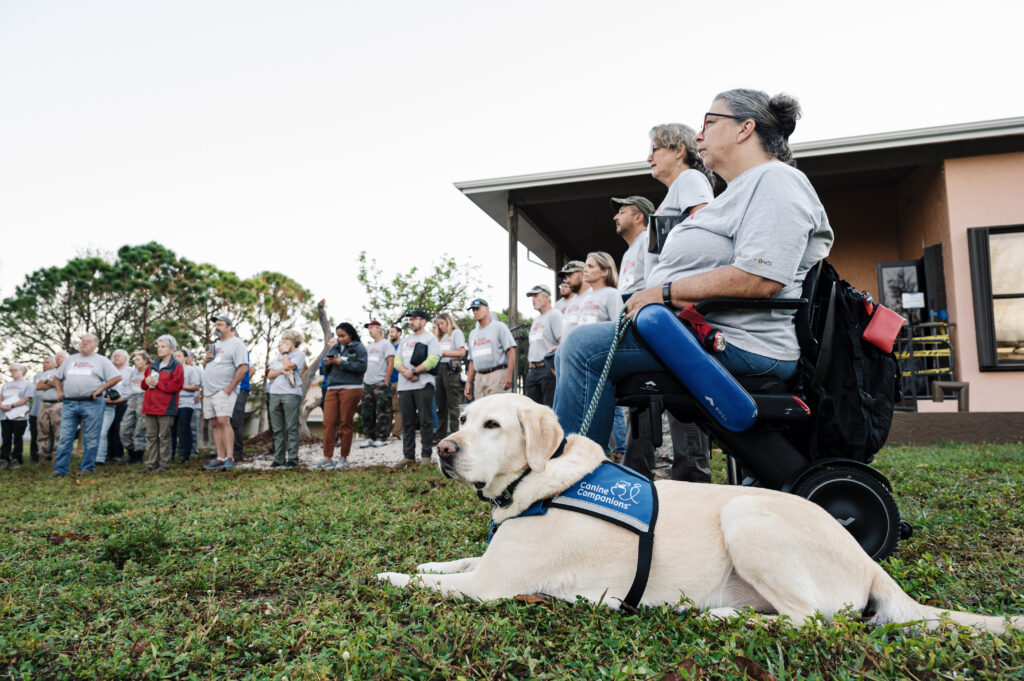
Practical Tools: What Universal Design for Operations Looks Like Before Deployment and on the Ground
The idea of UDO may have been conceptual at the regional leadership session, but it didn’t stay theoretical for long. Leaders quickly embraced the prospect of UDO and began developing concrete practices that could be implemented across three operational domains: communications, planning, and support.
Communications and Briefings: On every op, Incident Commanders should conduct briefs away from loud staging areas, use written summaries alongside verbal briefs, and provide printed or digital mission sheets at the start of each day.
Using plain language and cutting the jargon—whether it’s TR speak or military lingo that may be unfamiliar to first-time deployers and civilian Greyshirts—is also essential. Where possible, leaders should also assign a communication buddy for Deaf or hard-of-hearing members in dynamic environments. These changes benefit everyone, not just team members with hearing considerations.
Site and Task Planning: Physical access details belong in the Advon site survey, not in an on-site scramble. While assessing potential FOBs and billets, the Advon team should note whether the sites are accessible: For example, if a potential FOB has accessible entrances, whether billeting is reachable by those who cannot navigate stairs, and whether ground conditions around either are so littered with disaster debris like mud and broken glass as to make them difficult to navigate. The Advon team should then relay that information to the broader mission planning team, who might even embed the intel in the “logistics notes” of the sites. Mobilization, or Mob, should then incorporate the accessibility information into dispatch instructions.
Leaders and planners should also pre-identify tasks for varied physical capability levels and build task rotation plans that flex around ability. C&G staff should designate accessible rest and rehab areas at every worksite.
Cognitive and Neurological Support: Having visual checklists and structured task breakdowns reduces cognitive load for everyone and is essential for team members managing TBIs, PTSD, or other invisible injuries. Limiting simultaneous instruction, allowing self-paced check-ins at staging, and designating quiet debrief spaces are low-cost changes with high readiness returns.
When physical access is embedded in the Advon information rather than discovered upon arrival, when cognitive load is considered in task sequencing, and when participation data is actually tracked in hotwashes and after-action reports, inclusion stops being aspirational and starts showing up in outcomes. As a result, briefings work for multiple communication styles, task assignments match actual capabilities, and no Greyshirt has to announce a barrier at 0600 on a disaster site.
The research backs this up: diverse teams make better decisions under pressure. Inclusive operations preserve institutional knowledge and extend volunteer careers. Every Greyshirt who deploys longer, at higher function, multiplies mission impact—not just for themselves, but for the communities we serve.
Applying Universal Design for Operations on Every Mission: Know Your Role, and Design for Everyone’s
While currently aspirational and in the process of being implemented, UDO isn’t a top-down mandate; it’s a shared responsibility across every level of the TRibe, from the individual Greyshirt to the Op Planner, and each role has a specific part to play.
Whether you’re a Greyshirt getting ready to serve on a service project, a member of the TRibe with a disability deploying on an operation, or a member of C&G standing up an op, here’s how to incorporate Universal Design for Operations to ensure maximum capacity.
Op Planners
Those responsible for getting an operation off the ground have the highest leverage and can make the greatest impact of all. Planners should provide access details about the FOB and billeting during the Advon stage.
Listing accessibility constraints or lack of constraints in the logistics section will allow Greyshirts with mobility constraints to decide whether or not to deploy on an operation.
Incident Commanders and Strike Team Leaders
On an op, ICs and STLs hold significant leverage. The shift from making assumptions to asking a simple question of deployers—”What do you need to contribute effectively on this mission?”—changes the entire dynamic of an operation. Never assume—ask Greyshirts where they add the most value.
Planning briefings for multiple communication modes, assigning roles to strengths rather than assumptions, and creating a culture where needs can be voiced without fear of losing deployment status are leadership decisions that cost virtually nothing and return significant operational value.
On an op, ICs and Strike Team Leaders should consider cognitive load, like how instructions are given, testing for understanding, providing information in chunks rather than rapid fire lists, and avoiding language with heavy instructions or giving too many steps at a time. Such accommodations will benefit the entire team.
Individual Greyshirts
Every Greyshirt—with or without a disability; with temporary disability like a recent joint replacement or a more permanent visible or invisible disability—should be prepared to communicate their restrictions and access needs, ideally prior to deployment. This kind of self assessment and willingness to communicate proactively with team leaders is not a sign of weakness, but is operational preparedness. It also ensures that every Greyshirt is enabled to work at peak capacity during an operation. Knowing about barriers before they arise both allows Greyshirts to support one another and serves as a kind of mutual accountability that makes strike teams effective.
Every Volunteer Leader’s Commitment Before the Next Activation
Before your next operation or service project, pick at least one action and own it: Some options include adding a UDO check to your Advon form, redesigning one morning brief for accessibility, or having a single 1:1 conversation with a Greyshirt about their deployment preferences—or proposing that an accessibility lens be added to their region’s after-action review template.
None of these requires budget approval or a policy change: they simply require leadership.
Every Greyshirt Earned that Grey Shirt
Universal Design for Operations is how we make good on that—not with words, but with systems, plans, and cultures built to honor every person who shows up to serve.
Team Rubicon isn’t for everyone, but everyone has a place in Team Rubicon. The question for every leader in the TRibe is whether our operations are actually designed to prove it.
Mission First. Greyshirts Always.
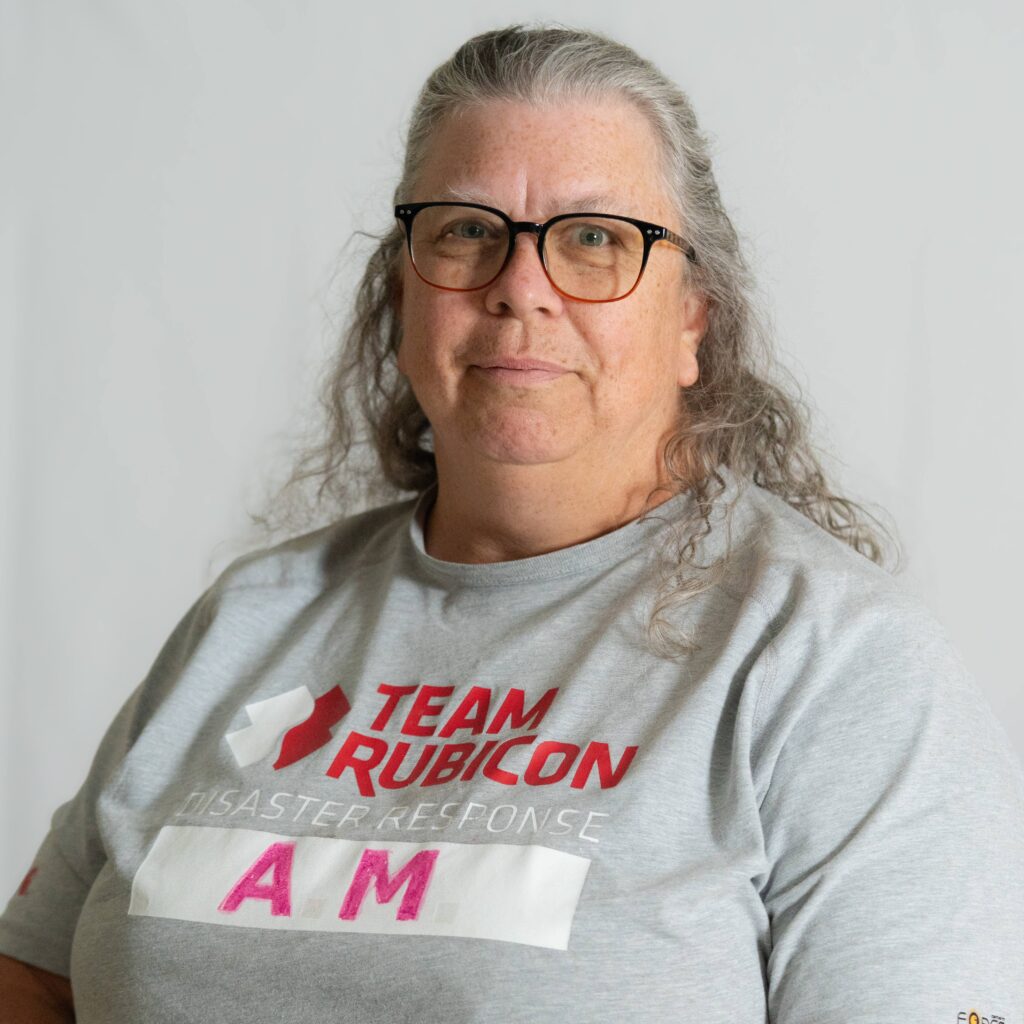
AM Dillon is a Team Rubicon Greyshirt and Volunteer Leader. A Disability and Inclusion Specialist, AM serves as an advocate for Greyshirts with disabilities and is a founding member of the TR Disability Action Group.
Greyshirts with Disabilities who want to advocate for and support Greyshirts with visible and hidden disabilities and support the UDO initiative should join the Greyshirts With Disabilities Community on Facebook.
Four Principles for Building a TRibe of Inclusion
Underneath all the practical tools, UDO rests on four cultural commitments that leaders were challenged to internalize and act on before their next operation:
- 01—Ask, Don’t Assume
“What do you need to contribute effectively?” is not a weakness question. It’s a leadership question, and it changes everything about how a mission gets planned. - 02—Design It In, Don’t Bolt It On
Identifying access needs during the op planning process costs nothing. Access failures on-site can cost mission success—and Greyshirt safety. - 03—Normalize the Conversation
Psychological safety is mission-critical. When Greyshirts can share needs without risking deployment status, the whole team gets stronger. - 04—Measure What Matters
Track role diversity and retention. Inclusion that doesn’t show up in your data isn’t happening—no matter how much you talk about it.


