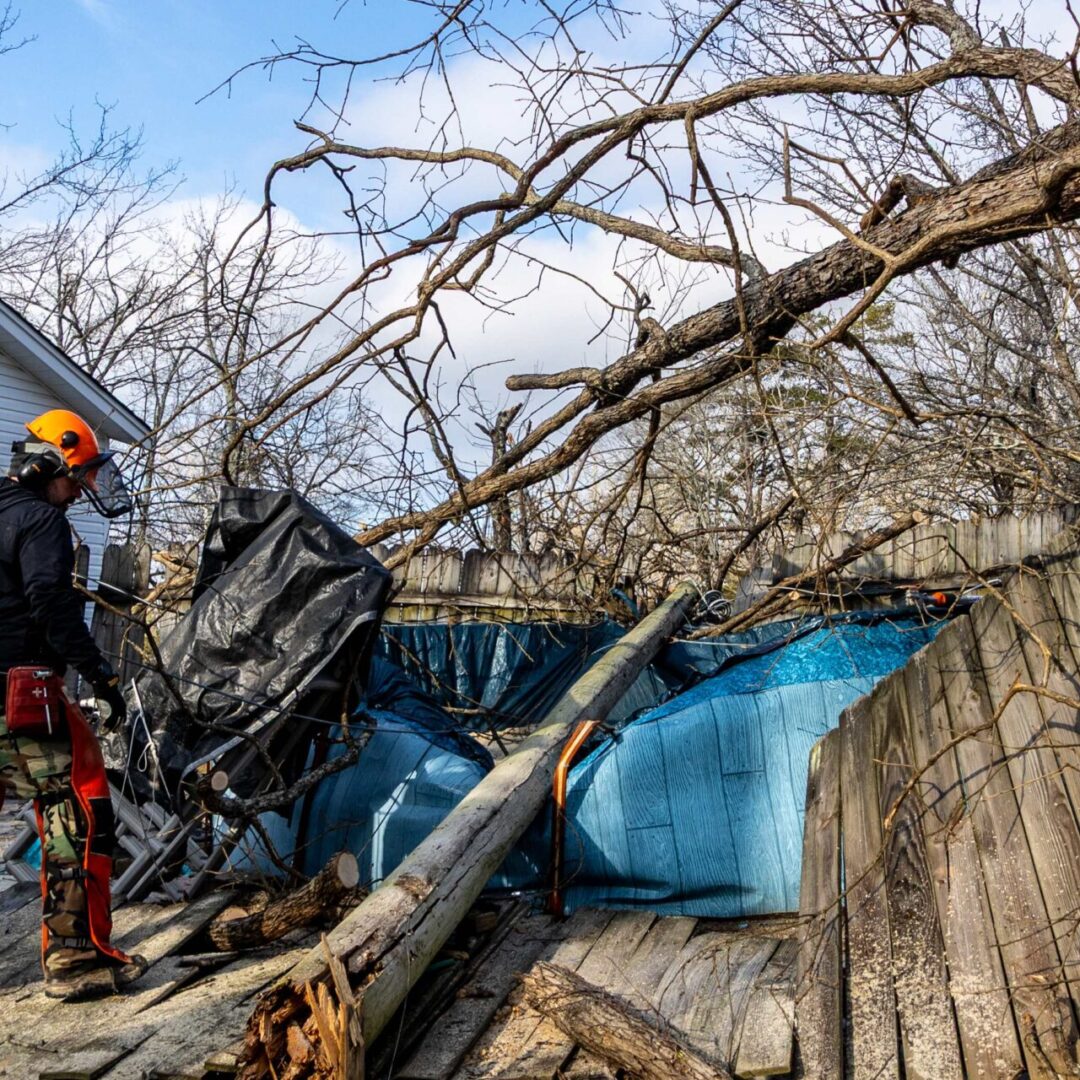
When a disaster strikes, Team Rubicon volunteers, or Greyshirts, step up quickly to serve survivors and help communities recover. For new Greyshirts trying to navigate the deployment process for the first time, it can seem mysterious. Here’s a breakdown of how to volunteer for disaster relief work and the Team Rubicon deployment process, plus details on who gets chosen for an op and more.
How to Deploy With Team Rubicon in Five Easy Steps
Step 1: Become a Greyshirt
The first step to deploying on a disaster response operation is to sign up and become a deployable Greyshirt.
Deployable Greyshirts are those volunteers who have completely filled out their profile in Roll Call, including having an emergency contact listed; completed a background check, and completed TR101, “Step into the Grey”, Team Rubicon’s introductory training series.
Step 2: Answer the Call to Action
Shortly after a disaster strikes and Team Rubicon has decided to stand up an operation to serve affected communities, Greyshirts will begin receiving texts and emails asking if they can deploy on an operation.
The first step in being chosen to deploy on an operation is to respond to a call to action that will come to your email or via a text message—or both. By responding to that CTA, Greyshirts indicate their desire and availability to serve on an operation.
Because not every volunteer can be chosen for the first week or two of an operation, when responding to a call to serve, Greyshirts should mark themselves available for as many flight waves as possible in order to increase the chances they’ll be asked to deploy sometime during the op.
Step 3: Reconfirm Availability

Once a volunteer makes the short list for an operation wave, they’ll receive a request to reconfirm their availability. This ensures Team Rubicon doesn’t reserve a spot on the operation or book a flight before, for example, the boss has approved the Greyshirt’s time off.
Greyshirts located within 450 miles of a disaster are often prioritized for deployment and will be expected to drive to the operation. Greyshirts located more than 450 miles from the operation are provided flights by Team Rubicon to the operation based on cost, logistics, availability, and operational needs. For domestic operations, Greyshirts traveling by air must be available for a minimum number of consecutive days—typically eight days—to align with listed flight waves for the operation.
Step 4: Await Dispatch Orders
After reconfirming availability, and once mobilization has selected you among the final list of Greyshirts deploying on specific dates, you’ll receive an email and/or text with your dispatch orders. Dispatch orders typically arrive at least 48 hours prior to deployment, though in earlier phases of response operations, that timeframe can be shorter.

Whether you’re deploying locally on a recon mission or to a far-off location, those dispatch orders will include details like a point of contact (POC) for your deployment, where to meet—aka your rally point—and when to be there.
Occasionally, a Greyshirt will receive a stand-down notification, indicating that something changed on the operation, operational needs, or with travel planning, and canceling the deployment at this time. Cancellations typically occur because needs on the operation have changed in some way, and the specialized skills a Greyshirt has may no longer be needed at that time.
Step 5: Look for a Travel Itinerary if Flying
On national operations that require a flight (versus regional, driveable deployments), the deploying Greyshirt will receive a travel itinerary and plane ticket via email from Gant Travel Management, and occasionally directly from the airline.
Greyshirts should never, ever buy their own plane ticket to an operation. Team Rubicon (with help from its incredible partners, like Airlink) will always purchase a plane ticket for you.
Greyshirts who are driving to an operation will not receive a travel itinerary but should expect their dispatch orders to include a rally point, rally point address, and a rally time—ie, the time they are expected to be at the operation for the first time. Greyshirts who are driving should call the on site POC to let them know what time they can safely arrive at the operation.
Behind the Scenes of the Deployment Process: How Greyshirts Are Selected for Operations
For everyone who has ever wondered how they get deployed with Team Rubicon, the answer is both simple and complex. On the simple side, one signs up to volunteer with Team Rubicon, completes their Greyshirt profile and background check, and responds to a call to serve when it comes. Still, choosing the right mix for an operation can be complex, and not every Greyshirts gets a call to serve on every single disaster relief operation with Team Rubicon. Invitations to deploy can even be sent in waves and over time, especially for extended responses.
Who receives the CTA?
Because each operation varies, so does the criteria for selecting Greyshirts eligible to deploy on it. In the immediate days after a major disaster like a hurricane, for example, Team Rubicon might first reach out to sawyers who have completed their route clearance sawyer training and Greyshirts who are certified Heavy Equipment Operators.
Later, once an operation has stood up in full, Team Rubicon will put out a call for general responders—Greyshirt who will spend a week removing disaster debris, mucking damaged houses, and more.
The Science Behind How Disaster Relief Volunteers are Selected
Once a disaster relief operation is in full swing, the mobilization team will send out a call for Greyshirts to register their availability for an operation. Sometimes, the call for disaster relief volunteers will go out broadly to all deployable Greyshirts, anywhere in the U.S. Other times, the call to register for an operation will go out only to Greyshirts within 450 miles of an operation—those who can drive, rather than having to fly.
Not every Greyshirt who registers their availability for an operation will be chosen for it. Typically, the mobilization team chooses Greyshirts for deployment based on their specialized training and skills, and with a focus on the specific skills needed for the operation.
For example, a tornado response might need a heavy contingent of skilled sawyers as well as enough general responders who can swamp debris to the curb, while a flooding response may be heavily weighted toward general responders who can muck homes and clear flood debris.
Typically, the mobilization team also prioritizes those with the skillsets sought who are closest to the operation within driving distance, then expands the search farther out if flights are authorized.
Finally, just because a Greyshirt isn’t chosen to deploy with the first or second wave of responders doesn’t mean they’ll never get to respond to the disaster. Major disasters regularly require more Greyshirt assistance weeks and even months after the disaster—long after the crisis has faded from the news and when survivors begin to feel forgotten. Take, for example, Hurricanes Helene and Milton, which saw Greyshirts responding in North Carolina nearly a year after the hurricanes devastated communities. Or, how in January of 2026, roughly three months after Hurricane Melissa made landfall in Jamaica, Team Rubicon deployed its eighth wave of Greyshirts to the Caribbean island nation to serve survivors.
When you finally do get chosen to deploy on an operation, it’s time to pack your Go Bag.