
After the Los Angeles-area wildfires last year, I volunteered on a couple of the several operations that Team Rubicon launched in response. In Altadena, while we were erecting temporary fencing around burned lots to dissuade squatters and illegal garbage dumping, I met Zhongming Liu, a fellow Greyshirt from Nevada by way of the People’s Republic of China.
A Chinese citizen going to university here in the U.S., and he was there in LA with me to serve strangers devastated by the fires—to volunteer some of what was certainly limited time for a pre-medical student.
“This is the most American thing about me,” Zhongming explained to me on another Team Rubicon operation a few months later. “My family back in China would never understand why we choose to offer our time for free to others.”
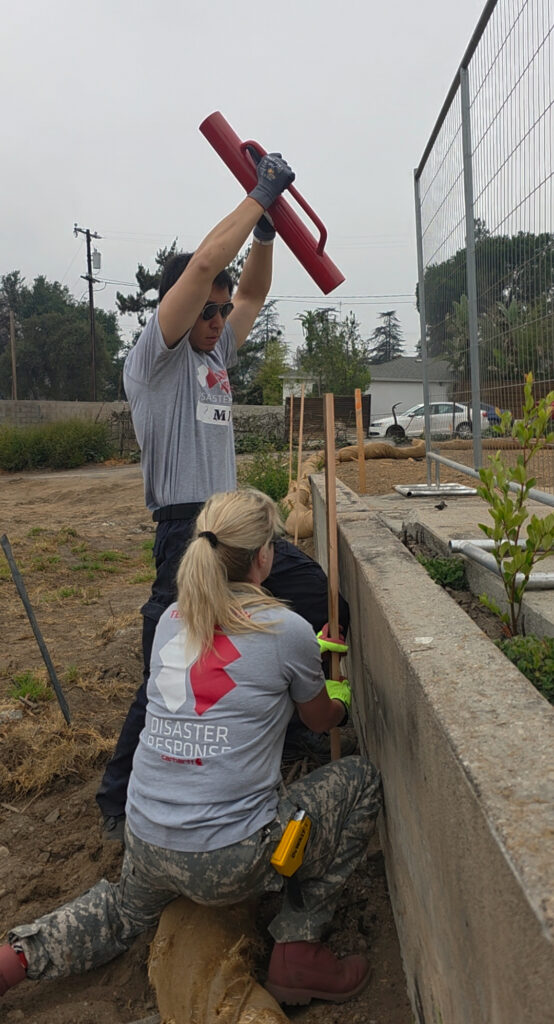
That statement resonated with me, an American who grew up and lived most of my life in Europe, because it put into words something I noticed but hadn’t been able to articulate yet: Americans volunteer a lot. They volunteer more than the communities I grew up around in southern and western Europe.
Actually, Americans volunteer more than just about everyone else on Earth, it turns out.
In a 2018 report, the United Nations Volunteer Program describes Americans as more generous with their time and money than citizens of any other nation. While much ink has been spilled about our alleged stinginess or selfishness, in an article in Philanthropy Roundtable Professor Arthur C. Brooks, director of the Nonprofit Studies Program at Syracuse University’s Maxwell School of Citizenship and Public Affairs, looked at the evidence comparing Old and New World levels of philanthropic giving and volunteering and concluded that “Americans privately give and volunteer far more than Europeans do.”
In a January 2026 report, the international volunteer recruitment and monitoring organization Volunteer FDIP listed the biggest players in volunteering worldwide and described us unambiguously: “People from the USA are top in the list of volunteering.”
Why Americans Volunteer More Than Most Countries
A common explanation for this disparity in charitable behavior is that America is a rich country; we have more disposable income and free time to spend on strangers. A study on the demographics of charity across 22 countries published last year in the scientific journal Nature, at least partially, refutes that suggestion. Their results show that citizens from low-income countries like Jamaica and Sierra Leone volunteer at rates comparable to the U.S., while ones from high-income countries like Japan and Italy do so far less often. In their World Giving Index, a survey of 1.5 million people in 127 countries, the Charities Aid Foundation says that the USA has “an unrivaled reputation for philanthropic giving.”
Consistent definitions of “charity” and “volunteering” are elusive in the literature, but the UN, researchers at Nature and several universities, independent philanthropic industry organizations, and the U.S. government agree that at least 70% of Americans donate money to charity and around 40% of us volunteer our time.
In many ways, America runs on volunteers. From polling booths to the Boston Marathon to elementary school recess monitors to disaster response, volunteers are crucial to daily life as well as to special events like elections or athletics. We rely on each other for some of the most basic, and most important, things in our society. As a PBS headline this year said in a piece about the 250th anniversary, “the spirit of volunteering is a defining part of America’s identity.”
And it has been that way since before the Revolution.
The History of American Volunteerism
The American tradition of volunteering began even before the United States of America did. America’s chief contributor to the Enlightenment, Benjamin Franklin, is credited with inventing the idea of a volunteer fire department in 1736. Firefighting brigades had existed prior to Franklin, but those were entities that people had to pay to be part of—fires on property without dues payers were left to burn.
Franklin’s innovation, according to the Benjamin Franklin Historical Society, was for volunteers to protect their community, and not just someone’s property. The first brigade was composed of 26 volunteers, but the idea quickly caught on, and more volunteer firefighting brigades were formed across the nation. Today, some 70% of America’s firefighters are volunteers.
The American Revolution would have been stillborn without volunteers. From the famous Minutemen militia forces to the Continental Army, the fledgling nation was defended by people who volunteered to do so. George Washington refused a salary as Commander-in-Chief for the entire war, insisting on only being reimbursed for personal expenses, which can still be seen at the George Washington Presidential Library at Mount Vernon. A handful of people funded the Revolution in its most dire moments, such as Haym Salomon who, as detailed at the American Battlefield Trust, “personally loaned to the American cause $650,000,” ultimately bankrupting himself in the process.
The movement to abolish slavery was heavily dependent on volunteers. The thousands of Americans who helped enslaved people escape bondage drew no paychecks from the informal Underground Railroad. Harriet Tubman had to actively fundraise from other people for her antislavery work—while slavers placed several bounties on her head, worth up to $1.5 million in modern terms, according to the National Women’s History Museum. Fighting for freedom, it should be noted, does not historically pay very well, no matter the era or the cause.
Helping Strangers Is Part of America’s Identity
Foreign visitors to young America in the 18th and 19th centuries frequently remarked on the habit of citizens to help each other in all walks of life, most notably the French writer, historian, and diplomat Alexis de Tocqueville in his famous two-volume Democracy in America. Americans tend to “make great and real sacrifices to the public welfare,” Tocqueville wrote after his travels across the country in the 1830s. “They hardly ever failed to lend faithful support to each other.”
I’ve lived in several countries and traveled to dozens more, and my experience aligns with Tocqueville’s and Greyshirt Zhongming’s observations: Americans truly are a breed apart, altruistic almost by default. Right now, the press is replete with stories from modern travelers to America for this year’s World Cup echoing Tocqueville: “Something new for me is how friendly and outgoing everyone is,” as Reuters reported a Swiss fan’s description of his experience here.
We Americans go out of our way to be polite and of service to others, and we’ve always been that way. Sociologists and historians can bicker about why that is, what led Americans to such an atypical ethos of happy helpfulness—but for me, it’s enough to know it is real.
What Disaster Relief Taught Me About Why Americans Volunteer
I am never so proud to be an American as I am when I’m wearing the grey shirt of Team Rubicon and serving alongside people I’ve never met before in a common goal of helping other people that none of us have met before either. Strangers helping strangers might be the cheat code to the American psyche; don’t try to understand why we want to help, just accept that we do. I am grateful to my fellow Greyshirts for demonstrating this to me in predictable regularity and especially to Zhongming for spelling it out to me with such clarity.
“There shouldn’t be a reason behind a desire to help others,” said Zhongming. “We do it because we want to, and it’s the right thing to do.”
According to Texas A&M University English professor Dave Wilton, the word “volunteer” comes to us from the Latin noun “voluntas,” meaning a will or desire. Which is precisely what Zhongming explained to me: we volunteer to help because we want to.
Americans are the people who want to help. And we do. In all arenas of life, Americans step up to serve. I suppose then that the answer to why Americans volunteer so much is simple: it’s just who we are.
For all but 38 of the U.S. military’s 250-year history, it was a purely volunteer force. The U.S. has less than five percent of the world’s population but, according to WikiCharities, accounts for over 18 percent of charities. Even when a global pandemic hits, Americans will buck the global trend and, per Axios, donate and volunteer even more. Americans are consistently ranked as the most altruistic with their time and money, and it doesn’t matter what “kind” of American you are: according to LendingTree, charitable giving crosses religious, ethnic, economic, age, and regional barriers—Americans really just do like helping other people.
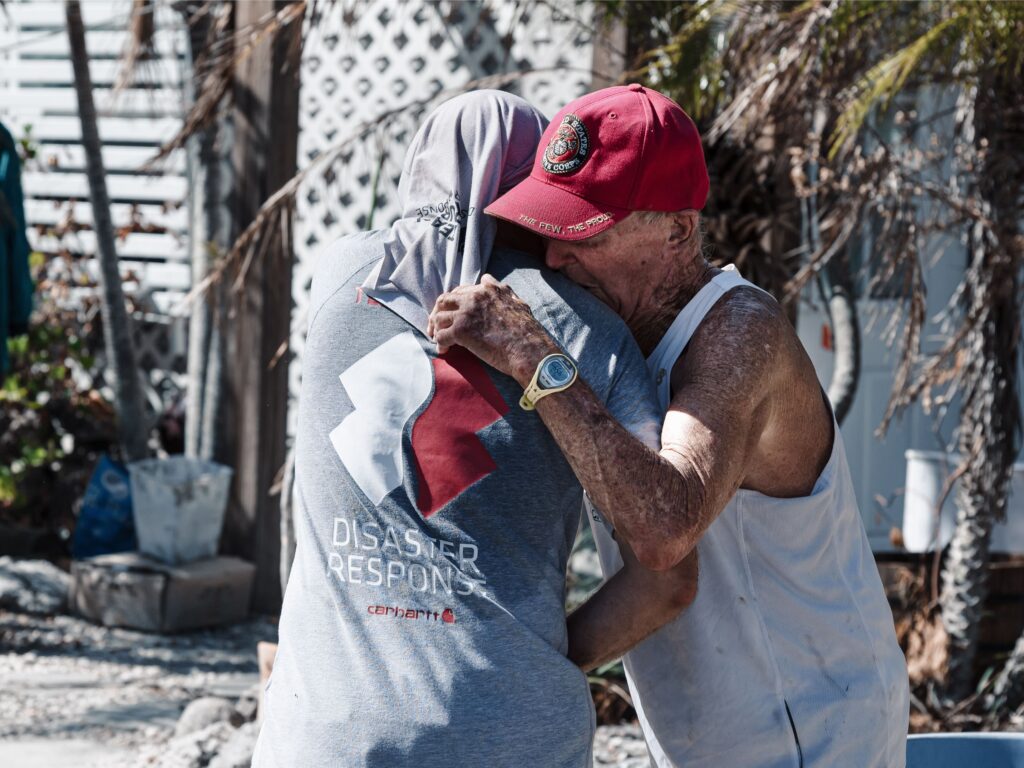
One of the largest and most consistent challenges for volunteer-based organizations, including Team Rubicon, is finding people to do the volunteering. Many different factors play into an individual’s likelihood of volunteering, such as age, gender, and socio-economic status but perhaps one of the most important is nationality. Because here Americans shine. If you could ask potential volunteers around the world just one question to determine if they’d follow through and actually volunteer, the best one may be: “Are you American?”
Americans are the most generous people on Earth, we’ve been that way for centuries, and we have generally very little competition for the title. As Professor Brooks stated: “a full understanding of the evidence makes it clear that private charitable behavior is one way that Americans are truly exceptional.” We should be proud of that. I know I am. Happy Birthday, America.


